

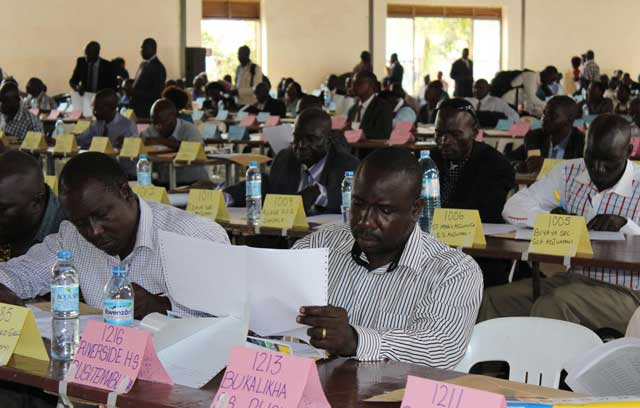

The placement of learners entering Senior One starts on Thursday, February 12, and will continue through Friday, February 13, at Lugogo Multipurpose Hall in Kampala. The exercise marks an important milestone for thousands of candidates who recently completed the 2025 Primary Leaving Examination (PLE).
Across the country, parents and pupils are keenly following the process, especially as traditional “big schools” revise their cut-off points. Some schools have increased their required aggregates in response to strong national performance, while others have slightly lowered theirs to fill available vacancies.
Cut-off points are largely determined by overall national results and the capacity of individual schools. In years when candidates perform strongly, competition for places in leading schools becomes stiffer, often pushing aggregates higher. On the other hand, schools with unfilled positions may reduce their entry requirements to attract more learners.
Last year, leading schools in Kampala and surrounding metropolitan areas maintained highly competitive benchmarks, with Aggregate 8 serving as the general standard. Among them were Budo (5), Gayaza High School (6), Makerere College (7 and 8), Nabisunsa (7), Mt St Mary’s Namagunga (7), St Mary’s College Kisubi—SMACK (5), St Mary’s Secondary School Kitende (5 and 7), Ntare School (7), Trinity College Nabbingo (6), Kawempe Muslim Secondary School (7 and 8), and Kibuli Secondary School (6 and 7).
The selection exercise is intended to ensure merit-based placement, particularly in government-aided traditional schools and other highly sought-after institutions. Education officials emphasize that the process promotes fairness and transparency in allocating limited spaces.
However, some critics contend that the system tends to favor elite and top-performing schools, leaving learners with average results uncertain about their placement prospects.
While certain prestigious schools uphold strict admission standards, many private secondary schools accept students who meet minimum pass requirements, provided families can manage tuition and related expenses. This flexibility offers hope to parents whose children may not have achieved top aggregates but are eager to proceed with their studies.
Nonetheless, some schools—both government and private—continue to turn away candidates with weaker grades, citing performance expectations and limited capacity.
Uganda has an extensive network of secondary schools nationwide, and education experts often remind parents that academic success should not be measured solely by admission to a small group of prestigious institutions. They stress that consistent guidance, discipline, and dedication to learning play a far greater role in long-term achievement.
As the two-day exercise progresses, thousands of families will soon learn where their children will begin the next stage of their academic journey. While competition for top schools remains high, Uganda’s education system still offers diverse pathways to success.